
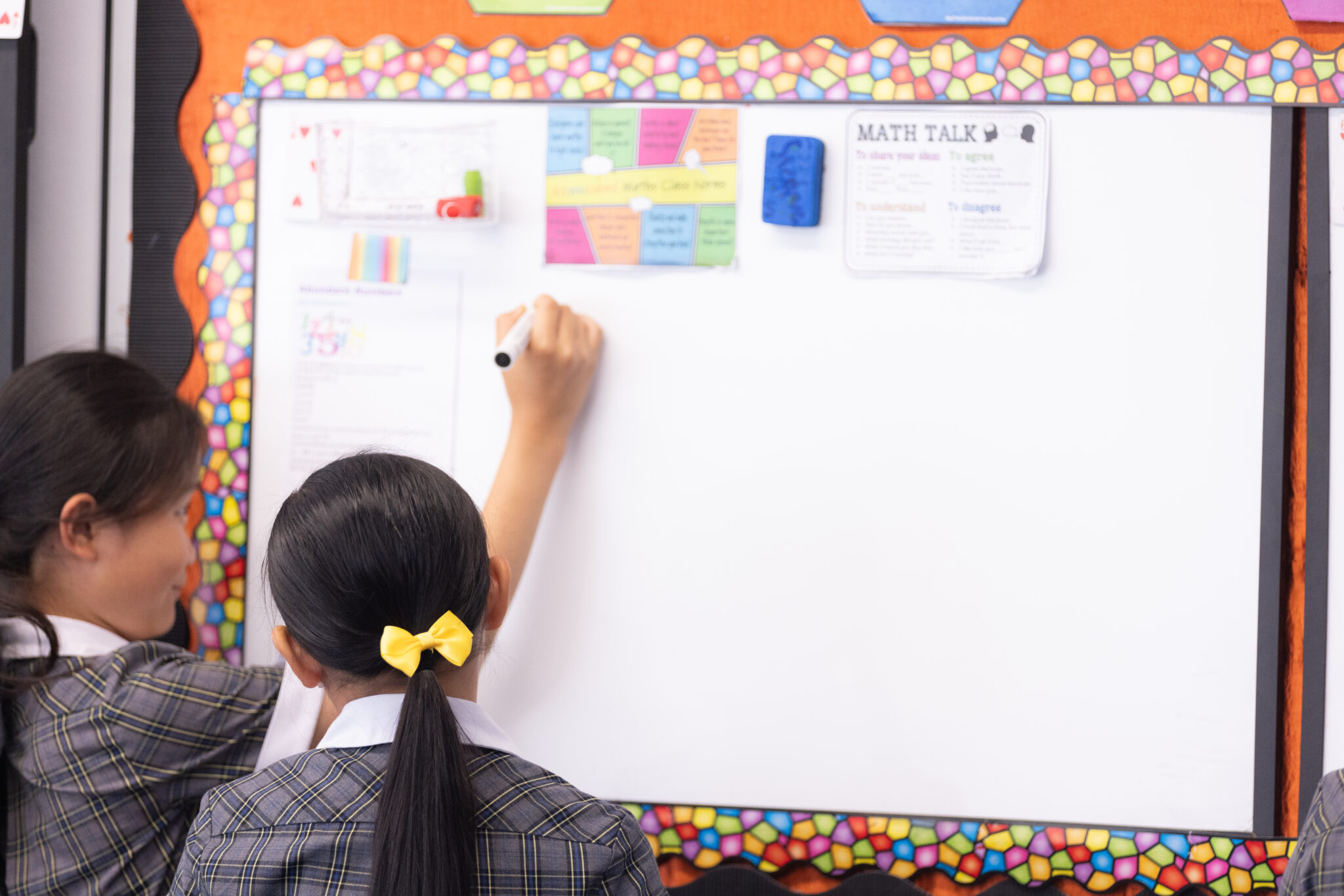
At the start of this year, our Junior School maths specialist, Ms Amy Schey, said one thing to every girl in her classes: the answer is only part of the story. What matters just as much is the thinking that got you there.
For a parent, that might sound like a nice sentiment rather than a real shift in how maths is taught. In practice, it changes quite a lot about what a maths lesson looks like here.
Why the “how” matters as much as the answer
The current NSW Mathematics Syllabus places real weight on reasoning, not just correct answers. Instead of memorising a procedure and applying it as fast as possible, girls are asked to explain their thinking, justify the choices they made, and describe the strategy they used. This reflects what leading maths education researchers, including Stanford’s Professor Jo Boaler and RMIT’s Professor Dianne Siemon, have long argued: children understand mathematics more deeply when they are making connections and putting their reasoning into words, not just producing an answer.
What this looks like in the classroom is girls who are willing to sit with a hard problem, try something, get stuck, and try again, rather than reaching immediately for the quickest route to a tick. That willingness, more than any particular technique, is what builds real confidence in maths.
A real problem, worked through properly
One of the ways this plays out is through NRICH, an open ended problem solving project run by the University of Cambridge. The problems are designed to have no single obvious method, which is exactly the point.
Recently, girls tackled a current NRICH problem called Hunting for Averages, and were asked to do something harder than solving it: to write up their solution clearly enough that someone else could follow it and arrive at the same place. For many girls, the writing was the harder half.
The results were strong enough that three students’ solutions, by Mollie, Isla and Chloe, were selected for submission to the NRICH team itself.
What stood out was not that the girls arrived at the same answer by the same route. They did not. Given an identical problem, each girl chose her own strategy, noticed different patterns, and explained her reasoning in her own way, and each still reached a sound conclusion. It is a useful thing for a child to learn early: there is rarely only one correct way to think.
None of this is really about one NRICH problem. It is about girls learning, early and often, that being temporarily stuck is a normal and even enjoyable part of thinking, not a sign that something is wrong. That habit, built in a Junior School maths classroom, carries well beyond it.